RSVP Plus - Free Wedding RSVP & Seating Platform
A free, open-source Hebrew wedding management platform that started as a system built for our own wedding and evolved into a hosted public service for digital invitations, personal RSVP links, guest management, seating and venue table lookup.
The problem
Planning our wedding exposed a fragmented workflow: invitation details, guest lists, RSVP updates, WhatsApp communication, seating decisions and entrance-day table lookup all lived in separate places. After using the system for our own event, I wanted to turn that solution into a free service other couples could actually use.
The solution
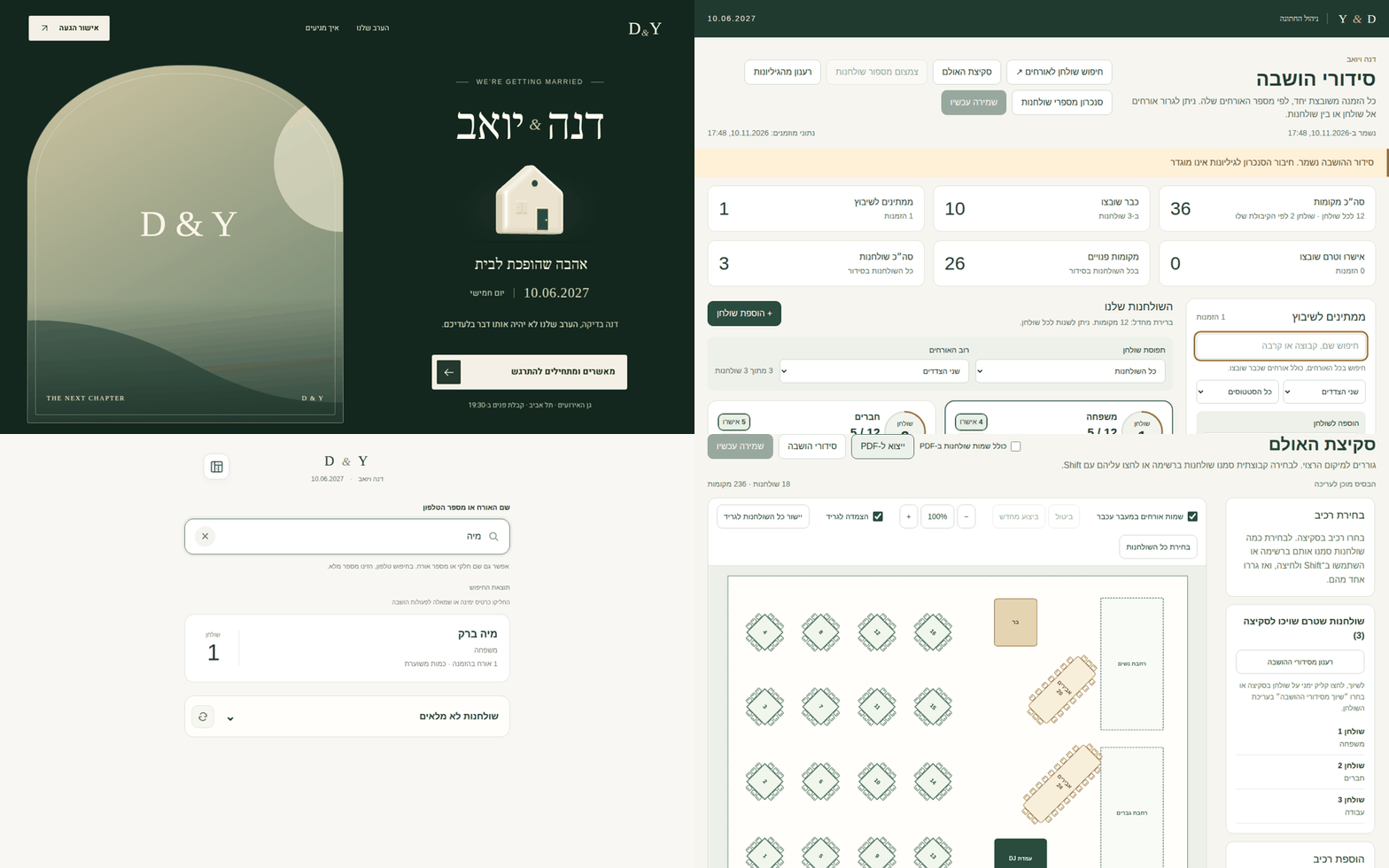
I defined the product requirements, workflows and architecture direction, then used AI-assisted development to evolve the original single-event system into a public hosted edition. Couples can try the full product without registration, move demo data into a new account, create an event, import guests from Excel or CSV, share signed personal invitations, receive RSVPs, arrange seating and generate a temporary staff table-search link for the venue.
How the system connects
The primary flow, from input to outcome.
- 01Couple
- 02Google Sign-In / Demo
- 03Event & Guest Management
- 04Signed Personal Invitations
- 05Guest RSVP
- 06Seating Planner
- 07Staff Table Search / Print & Export
- 08Automatic Retention
The impact
- Built and used for our own wedding before being generalized into a public product.
- Released as a free public service at rsvp.hamisrd.co.il with no advertising.
- Published as an MIT-licensed open-source project with a fully inspectable implementation.
- Designed for up to 300 invitations and 500 invited guests per event within the hosted free-tier limits.
What I owned
- Product requirements & UX
- Workflow and system design
- Security and privacy requirements
- AI-assisted development direction
- Code review, QA & regression cycles
- Open-source release & hosted deployment
Technical highlights
- Multi-tenant hosted edition with Google sign-in and event-scoped data isolation.
- Signed, expiring and individually revocable invitation links with guest-count limits.
- Guest management with manual entry, Excel / CSV paste and import, groups and WhatsApp-ready personal links.
- Seating workflows with table capacity validation, drag-and-drop assignment, group-based auto seating and printable outputs.
- Temporary staff table-search links designed to reveal only the assigned table rather than the guest database.
- A local-only browser demo that can transfer event details, guests, tables and photos into a newly created account.
- Privacy-focused lifecycle: no advertising or marketing tracking, user export and deletion, and automatic event-data deletion 90 days after the event.
- CI verifies type checking, zero-warning lint, unit/integration tests, deployment dry-run and Playwright end-to-end browser flows on every change to main.
A closer look.
Real screens from the production system. Open a screen to explore the details.
AI-assisted development was used extensively: Codex wrote much of the implementation while I owned the requirements, product decisions, architecture direction, review, QA, release decisions and production outcome. The original system was used at our own wedding; the current hosted edition is a separate free public service with explicit usage limits and no SLA.